
A History of the Saffron Walden Corn Exchange – part two: The Woolstaplers’ Hall
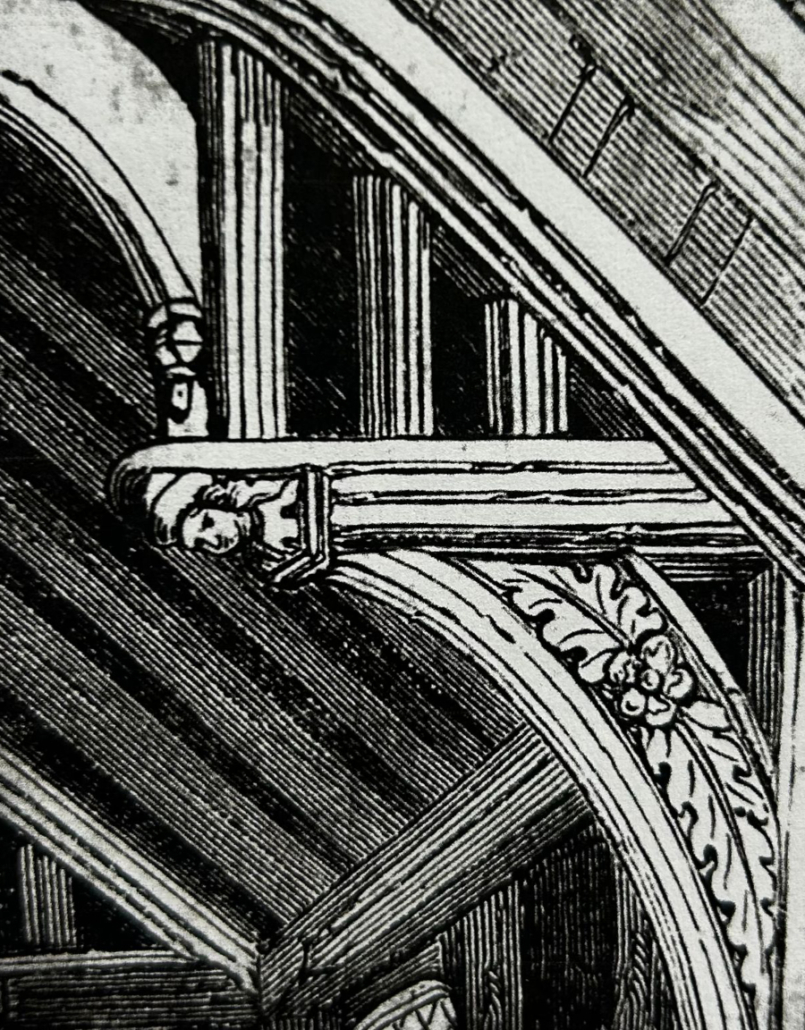
In 1848, old timber-framed buildings on the west side of the Market Place were torn down to make way for a grand Corn Exchange. During the demolition stage, workmen came across a previously completely concealed small, ancient hall. “The hall had been almost completely hidden by the subdivision of walls and ceilings used to transform the old building into dwellings.”
When this hall was discovered, there was a particular interest in the carved heads found on the end of the hammer beams, each carved out of chestnut. While the complex of old buildings could date back to Edward IV’s reign, it’s possible that the construction date for the old hall could be from Henry VIII’s reign.
Eventually the old hall was pulled down and the site was levelled, the only surviving elements being the carved heads which were converted into shelf brackets. The heads were originally placed in Neville’s museum room at Audley End Mansion. When the collection in the museum room dispersed, they were kept on a shelf in a storeroom, where Martyn Everett was able to capture the images below.
Illustrations and information taken from Martyn Everett’s article ‘The Mysteries of the Woolstaplers’ Hall’ within Issue 19 of the Saffron Walden Historical Journal. Pictures of the heads used in this post belong to Martyn Everett.

